
As of 2 November 2026 (16 Kartik 2083). Rates are read from the Economic Bill 2083 as published by the Ministry of Finance (mof.gov.np), Schedule 3 (Clean Infrastructure Investment Fee), Schedule 4 (Road Construction Fee) and the customs tariff amendment, plus the English budget speech for FY 2083/84. Parliamentary dates are from Kantipur. Price changes are as reported by EV News Nepal on 13 July 2026. The customs department’s tariff page did not show a 2083/84 tariff book on our check date. Worked examples are our calculation, not official quotes.
The EV tax in Nepal for 2083 changed in one important way: the tax on an imported electric car now depends on what the car costs, not on how powerful its motor is. A small, cheap EV pays very little. An expensive one pays far more than before. This guide explains each layer of tax, shows what it adds up to at three price points, and lists which models moved up or down after the budget.
It is written for buyers and small importers who want to understand a showroom price, not for customs agents.
Quick answers
| Question | Answer |
|---|---|
| What changed? | Customs duty and the main levy on EVs now follow import (CIF) value instead of motor power in kW |
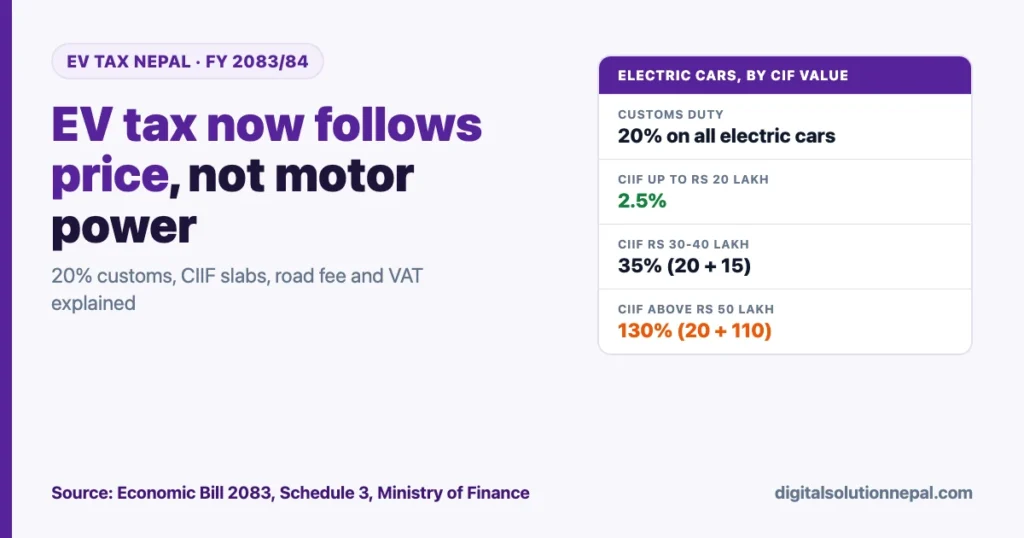
| Customs duty on electric cars | 20 percent, the same for every price band |
| Excise duty on EVs | Removed and replaced by a Clean Infrastructure Investment Fee (CIIF) |
| CIIF on cars, CIF up to Rs 20 lakh | 2.5 percent |
| CIIF on cars, Rs 20 to 30 lakh | 20 percent |
| CIIF on cars, Rs 30 to 40 / 40 to 50 lakh | 35 percent / 90 percent (base 20 plus 15 or 70) |
| CIIF on cars, above Rs 50 lakh | 130 percent (base 20 plus 110) |
| Road construction fee | 5 percent; 2.5 percent if CIF is up to Rs 20 lakh |
| VAT | 13 percent at import |
| When announced | Budget speech, 29 May 2026 (15 Jestha 2083) |
| Law authenticated | 14 July 2026 (30 Asar 2083), as reported by Kantipur |
What the EV tax in Nepal 2083/84 changed: from motor power to price
Until FY 2082/83, an imported electric car paid customs duty and excise duty in slabs set by peak motor power. As reported by Nepal Drives when the FY 2082/83 budget left them unchanged, the slabs were:
| Peak motor power | Customs duty (old) | Excise duty (old) |
|---|---|---|
| Up to 50 kW | 15% | 5% |
| 51 to 100 kW | 20% | 15% |
| 101 to 200 kW | 30% | 20% |
| 201 to 300 kW | 60% | 35% |
| Above 300 kW | 80% | 50% |
That system had a known weakness. A cheap car with a strong motor could pay more than an expensive car with a modest one, and importers had a reason to declare low motor ratings. Mero Auto reported in May 2025 that the Auditor General’s 62nd annual report estimated Rs 3.77 billion in lost revenue from importers under-declaring motor power at Rasuwagadhi and Tatopani customs.
The FY 2083/84 budget speech (paragraph 69(c) of the English translation) states the change in one line: customs duty on electric vehicles moves to an ad valorem basis, replacing the peak-power structure, and a Clean Infrastructure Investment Fee is levied at customs to fund domestic production, charging stations and battery management.
In the Economic Bill, the twelve old kW-based tariff lines under heading 8703.80 (electric passenger cars) were replaced by two: 8703.80.91 for cars imported unassembled and 8703.80.99 for all others. Both carry 20 percent customs duty.
The Clean Infrastructure Investment Fee, read from the bill
The CIIF sits in Schedule 3 of the Economic Bill. Three points in the text matter for buyers.
First, the fee applies to electric vehicles imported into Nepal or produced in Nepal, not only to imports. Second, for passenger cars the base rate is 20 percent, and sub-clause (2) then sets value bands. Third, sub-clause (3) says the fee is charged on the customs value plus customs duty, not on the CIF value alone.
The band wording is where most online confusion comes from. The bill says cars with a CIF value up to Rs 20 lakh pay “only” 2.5 percent, and that cars above Rs 30 lakh pay an “additional” (थप) 15, 70 or 110 percent. Our reading, which matches the Finance Ministry’s own clarification reported by Arthikpati on 31 May 2026 that the top rate goes “up to 130 percent”, is that the additional rates sit on top of the 20 percent base.
| CIF value of the car | CIIF rate (our reading of Schedule 3) |
|---|---|
| Up to Rs 20 lakh | 2.5% |
| Above Rs 20 lakh to Rs 30 lakh | 20% (base rate) |
| Above Rs 30 lakh to Rs 40 lakh | 35% (20 + 15) |
| Above Rs 40 lakh to Rs 50 lakh | 90% (20 + 70) |
| Above Rs 50 lakh | 130% (20 + 110) |
Some explainers list 15, 70 and 110 percent as the full rates. That reading leaves the Rs 20 to 30 lakh band with a higher rate than the Rs 30 to 40 lakh band, which does not make sense, and it conflicts with the ministry’s statement.
Other electric vehicles carry flat CIIF rates in the same schedule, with no value bands:
| Vehicle type (electric only) | CIIF |
|---|---|
| Electric motorcycles and scooters (8711.60) | 2.5% |
| Electric three-wheelers (8703.80.11 and .19) | 2.5% |
| Electric buses and microbuses for 11 or more people (8702.40.10 and .20) | 2.5% |
| Other electric 8702 vehicles | 5% |
| Electric pickups, single cab / double cab | 5% / 10% |
| Electric trucks, tippers, delivery vans | 5% |
Road construction fee and VAT
Schedule 4 of the bill sets a road construction fee (सडक निर्माण दस्तुर), collected at customs for imports and at registration for vehicles made in Nepal. For electric cars under 8703.80.91 and 8703.80.99 it is 5 percent. Clause (5), added in the version on the ministry website, cuts it to 2.5 percent where the CIF value is up to Rs 20 lakh. Annapurna Television reported on 3 June 2026 that this concession was not in the bill first tabled in Parliament. Electric three-wheelers pay a flat Rs 10,000 per unit.
The schedule defines the value for an import as the price including every tax, duty, fee and charge levied at customs except VAT. VAT at 13 percent then applies on top. The order matters, because each layer is charged on the layers before it.
Worked examples: Rs 20, 35 and 60 lakh CIF
The table below follows the order in the bill: customs on CIF; CIIF on CIF plus customs; road fee on everything so far; VAT on everything so far. All figures are our calculation, in lakh rupees, before the importer’s margin, transport, insurance, registration and the provincial annual vehicle tax.
| Step | CIF Rs 20 lakh | CIF Rs 35 lakh | CIF Rs 60 lakh |
|---|---|---|---|
| Customs duty 20% | 4.00 | 7.00 | 12.00 |
| CIIF rate | 2.5% | 35% | 130% |
| CIIF amount | 0.60 | 14.70 | 93.60 |
| Road fee rate | 2.5% | 5% | 5% |
| Road fee amount | 0.62 | 2.84 | 8.28 |
| VAT 13% | 3.28 | 7.74 | 22.60 |
| Cost after taxes | 28.49 | 67.27 | 196.48 |
| Taxes as share of CIF | 42% | 92% | 227% |
The table shows how steep the bands are. A car one rupee above Rs 20 lakh CIF moves from 2.5 percent CIIF and road fee to 20 and 5 percent. By our calculation the tax-paid cost jumps from about Rs 28.5 lakh to about Rs 34.2 lakh at that line, roughly Rs 5.7 lakh for one extra rupee of value. Similar cliffs sit at Rs 30, 40 and 50 lakh, and the one at Rs 40 lakh is the largest: about Rs 76.9 lakh just below it and about Rs 108.2 lakh just above.
Our reading of the practical effect: importers now have a strong reason to source variants that land just under a band line, and buyers will see more models priced to fit below Rs 20 lakh CIF.
How prices changed after the budget
EV News Nepal published a list of revised prices on 13 July 2026. The pattern fits the new structure: cars whose CIF value falls in a low band, or which had powerful motors under the old system, fell or rose a little; cars in the top bands rose sharply.
| Model | Price before | Price after |
|---|---|---|
| Leapmotor B10 | Rs 60 lakh | Rs 54.99 lakh |
| Suzuki e-Vitara | Rs 49.99 lakh | Rs 48.99 lakh |
| MG S5 (range) | Rs 49.99 to 54.99 lakh | Rs 50.99 to 55.99 lakh |
| BYD Atto 3 Advanced | Rs 59.99 lakh | Rs 61.99 lakh |
| BYD Atto 2 | Rs 45.99 lakh | Rs 48.99 lakh |
| Proton e.Mas 7 (range) | Rs 46.99 to 57.99 lakh | Rs 56.99 to 67.99 lakh |
| BMW iX1 | Rs 2.00 crore | Rs 3.30 crore |
| Maxus MIFA 7 | Rs 1.25 crore | Rs 2.45 crore |
Showroom prices also move with the dollar rate and stock bought under the old rates, so not every change in the table is the tax alone. For current model-by-model prices, see our electric car price list, and the model pages for the BYD Atto 3 and the Tata Nexon EV.
When the EV tax in Nepal 2083/84 took effect
The budget was read on 29 May 2026. The House of Representatives passed the Economic Bill on 28 June 2026 (14 Asar 2083), and Kantipur reported that the President authenticated the budget bills, including the Finance Bill, on 14 July 2026. Kantipur’s report on the House vote said the bill applies from Shrawan, which began on 17 July 2026.
We could not find a Department of Customs notice giving the exact date the new EV rates were first applied at the border, so we do not state one. By November 2026, every EV cleared at customs is under the new structure.
How to read an EV price quote: a buyer’s checklist
- Ask the dealer which CIIF band the car was cleared under. The band is set by the CIF value at customs, not by the showroom price.
- Ask whether the stock was imported before or after the budget. Older stock may have been cleared under the old kW rates.
- Compare two variants of the same model across a band line. A small step in specification can mean lakhs in tax.
- Get the on-road price in writing: ex-showroom price, registration, insurance and the first year’s provincial vehicle tax as separate lines.
- Ask for the VAT bill with the dealer’s PAN. You need it for registration and for any warranty or consumer claim.
- For a car under Rs 20 lakh CIF, check that the lower road fee (2.5 percent) is reflected; it is a recent change.
- Remember the annual vehicle tax is provincial and separate. Bagmati, Gandaki and other provinces set their own EV rates.
Buying an EV? Get your papers and forms right
Digital Solution in Pokhara helps with vehicle-related document preparation and scanning, online forms for licences and registration, and digital skills so you can compare quotes and keep records yourself. गाडी किन्नु अघि कागजपत्र र फारमबारे हामीसँग सोध्नुहोस्।
Frequently asked questions
What is the EV tax in Nepal for 2083/84?
Electric cars pay 20 percent customs duty, a Clean Infrastructure Investment Fee from 2.5 to 130 percent depending on CIF value, a road construction fee of 5 percent (2.5 percent up to Rs 20 lakh CIF) and 13 percent VAT. Excise duty no longer applies to EVs.
Is the CIIF charged on the CIF value?
The band is decided by CIF value, but Schedule 3, sub-clause (3) of the Economic Bill says the fee is charged on the customs value plus customs duty. That makes the fee larger than a simple percentage of CIF.
Do electric scooters and bikes pay the new fee?
Yes, at a flat 2.5 percent under heading 8711.60, with no value bands. Their final prices also depend on customs duty and VAT; we have not covered two-wheeler customs rates here.
Does the fee apply to EVs assembled in Nepal?
Schedule 3 says the fee applies to electric vehicles imported into or produced in Nepal. Unassembled car kits (8703.80.91) carry the same 20 percent customs line and the same CIIF bands as built-up cars in the bill.
Why did some EVs get cheaper?
Our reading: models with strong motors but moderate import value used to pay high kW-based customs and excise. Under the value-based system they pay by price band, so some, such as the Leapmotor B10 and Suzuki e-Vitara in EV News Nepal’s list, came down.
Conclusion
The EV tax in Nepal for 2083 rewards cheap, efficient electric cars and makes expensive ones much dearer. Below Rs 20 lakh CIF the total tax load is about 42 percent of import value by our calculation; above Rs 50 lakh it passes 200 percent. Before you buy, ask which band the car was cleared under, compare variants across band lines and get the on-road price in writing. The band, not the motor, now decides most of the price.
Sources
- Ministry of Finance, Economic Bill 2083 (आर्थिक विधेयक, २०८३), Schedule 3 Clean Infrastructure Investment Fee, Schedule 4 Road Construction Fee and customs tariff amendment for heading 8703: https://mof.gov.np/
- Ministry of Finance, Budget Speech FY 2026/27 (English, unofficial translation), paragraph 69(c): https://mof.gov.np/
- Arthikpati, Finance Ministry clarification on misleading claims about the new EV tax (31 May 2026): https://www.arthikpati.com/content/2026/05/31/137251
- Karobar Daily, different tax on electric vehicles by value (Jestha 2083): https://www.karobardaily.com/news/380878
- Annapurna Television, finance minister changed rates in the Economic Bill (3 June 2026): https://tvannapurna.com/244123/2026/06/03/
- Kantipur, Economic Bill 2083 passed by the House of Representatives (28 June 2026): https://ekantipur.com/business/2026/06/28/economic-bill-2083-bs-passed-by-the-house-of-representatives-34-52.html
- Kantipur, President authenticates three budget-related bills (14 July 2026): https://ekantipur.com/business/2026/07/14/en/president-authenticates-three-budget-related-bills-40-40.html
- Nepal Drives, Budget 2082/83: taxes on electric vehicles remain unchanged (29 May 2025): https://www.nepaldrives.com/budget-208283-taxes-on-electric-vehicles-remain-unchanged
- Mero Auto, EV importers evaded Rs 3.77 billion by underreporting motor power: Auditor General (16 May 2025): https://www.en.meroauto.com/ev-importers-evaded-rs-3-77-billion-by-underreporting-motor-power-auditor-general/
- EV News Nepal, New EV tax in Nepal 2026: every EV price change (13 July 2026): https://evnewsnepal.com/news/new-ev-tax-in-nepal-2026-every-ev-price-change
- Department of Customs, customs tariff rates page (checked 2 November 2026): https://www.customs.gov.np/category/customs-tariff-rates/
This article explains published tax rules for general information; it is not customs, tax or purchase advice, and showroom prices change, so confirm with the dealer and the Department of Customs before you buy.

Rabin Paudel
Rabin Paudel is the Founder of Digital Solution, a Content Creator, and an AI Trainer. He shares practical and easy-to-understand content on Artificial Intelligence, Digital Literacy, Online Services, FinTech, and Technology. His mission is to make technology simple, accessible, and useful for everyone.
View all posts by Rabin Paudel →